
If there is one certainty in agriculture, it is that nothing stays the same. Potato growers have faced a wave of challenges in recent years, from the loss of key crop protection products such as Mancozeb to the emergence of fungicide-resistant strains of late blight. While many of these challenges have been anticipated, finding practical and effective solutions has rarely been straightforward.
At Agrii, we have spent several years focused on two key questions: how do we future-proof potato production and how do we make better use of technology, such as biologicals?
Moving beyond the "muck and magic" reputation
Biologicals have often struggled with a reputation problem. Terms such as "snake oil" and "muck and magic" have followed the sector for years, and in some cases those criticisms have been justified.
Many products have over-promised, delivered inconsistent results, or lacked clear guidance on when and how they should be used. Some can even produce negative outcomes if applied incorrectly. In potatoes, Agrii trials have occasionally shown products stimulating excessive foliar growth or reducing tuber numbers when used at the wrong time.
Rather than dismiss biologicals, Agrii took the view that greater scientific understanding was needed. It has committed to running year on year trials to identify what works, when to use it and when not to use it.
Investing in science to find practical solutions
Three years ago, Agrii made a significant investment in its future biologicals research programme by establishing a purpose-built glasshouse and polytunnel facility at its technology centre.
The £1 million investment was designed specifically to evaluate biologicals, adjuvants and micronutrients under controlled conditions and to identify quickly products with genuine agronomic value and eliminate those that fail to perform.
Since the programme began, Agrii has screened more than 350 products. Of those, only five have delivered results robust enough to justify further development and field evaluation.
This rigorous selection process ensures that growers are only presented with technologies that have demonstrated consistent and measurable benefits.
Understanding before applying
At the heart of Agrii's approach is a simple philosophy: "We have to understand it to be able to use it."
Before recommending any biological product, Agrii seeks to answer three fundamental questions:
- What is it doing to the crop?
- How is it working within the crop?
Is it actually delivering the effects claimed by the manufacturer?
The glasshouse programme allows researchers to investigate these questions in detail and build a clear understanding of product performance before moving to field-scale trials.
In the first year of potato-specific glasshouse work, researchers identified:
- Three potential biostimulants capable of improving nitrogen-use efficiency and calcium transfer
- A biological product showing potential as a future biocontrol against rhizoctonia.
Different planting temperatures could affect the efficacy of potentially highly efficacious biologicals
From glasshouse to field trials
Laboratory and glasshouse results alone are never enough. Once a product demonstrates promise, it progresses into Agrii's Potato Partnership field trial programme. These year-on-year field evaluations help answer the practical questions growers need addressed:
- Can the product be tank mixed with other inputs?
- What is the optimum application timing?
- How do weather conditions influence performance?
- Does temperature affect efficacy?
How does it fit within existing crop management programmes?
Only through repeated field validation can a biological earn its place in commercial potato production.
Biologicals and future disease management
Disease control is one area where biological technologies are already demonstrating real potential.
The withdrawal of Mancozeb has created challenges for both long-term late blight management and the control of Alternaria. As resistance pressures continue to evolve, growers need more diverse and resilient disease strategies.
Agrii trials have shown encouraging results from products such as Privest, which combines potassium phosphonate with ametoctradin. In trials involving populations of Oxathiapiprolin-resistant late blight, Privest reduced disease impact, highlighting the value of potassium phosphonate both as a plant defence elicitor and as a direct suppressive tool against the pathogen.
Alongside this, biostimulant products such as Innocul8 have shown promise when applied early in the season.
By activating the plant's natural defence mechanisms and improving early plant health and greening, Innocul8 effectively "primes" the crop, enabling it to better resist disease pressure and work alongside conventional fungicide programmes.
Rather than replacing fungicides, biologicals are increasingly being viewed as complementary tools within a stacked disease management strategy.
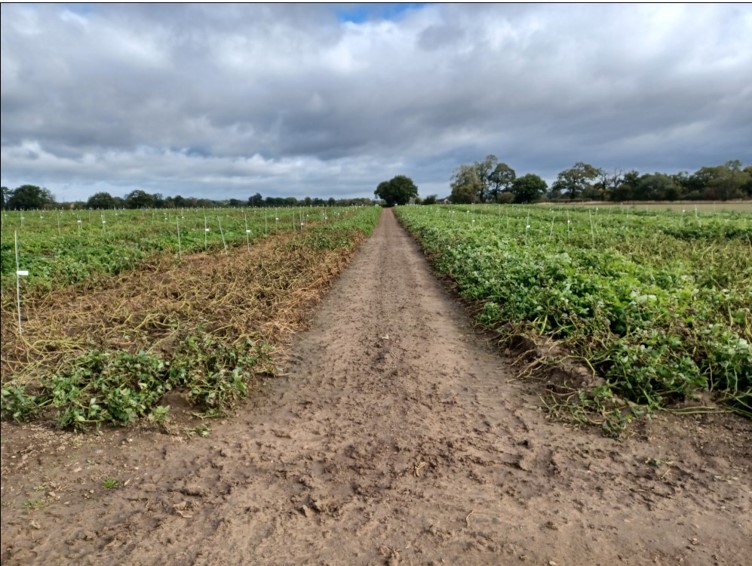
Left plot shows untreated control plants and right biostimulants and fungicide enhanced plants
Supporting nutrition and tuber quality
The role of biologicals extends beyond disease management.
One particularly promising area is nutrient transfer and utilisation. Improving the movement of nutrients into the tuber can enhance crop efficiency while helping to reduce physiological disorders that impact marketable yield.
Agrii researchers are evaluating biostimulants that improve nutrient translocation, particularly around calcium and nitrogen movement within the plant.
Nitrogen-use efficiency is another key focus. Work involving stable amine technologies, which provide a more readily available nitrogen source for crops, has produced encouraging results in both published research and Agrii's own glasshouse trials.
If these findings continue to be replicated in field conditions, there may be opportunities to reduce nitrogen inputs without compromising productivity.
Helping crops cope with stress
Stress management has traditionally been one of the main areas associated with biostimulants.
While many products focus on heat stress, Agrii's recent research suggests their benefits may extend much further. Trial work has highlighted products capable of helping crops manage temperature fluctuations more effectively, including both heat and cold stress events.
By reducing excessive plant respiration and maintaining physiological efficiency during challenging conditions, these technologies have shown significant potential to protect yield and improve crop resilience.
As weather patterns become increasingly unpredictable, this area of research is likely to become even more important.
The next frontier for biologicals
Agrii's biologicals programme continues to expand into some of the potato industry's most difficult challenges.
Current research is exploring biological controls and complementary biostimulant approaches for:
- Potato Cyst Nematode (PCN)
- Free Living Nematodes (FLN)
- Rhizoctonia
Wireworm
While none of these issues offer simple solutions, Agrii believes that by combining robust science with practical field evaluation and real-world performance they can help growers make informed decisions based on evidence rather than marketing claims.