


The SRUC 2026 plot at this year’s Potatoes in Practice is exploring a long-debated question for potato growers: is it better to plant according to a traditional calendar date, or should planting begin at the first sign of favourable environmental conditions to maximise time in the ground?
By comparing beds planted from the 5th May to 23rd June at seven-day intervals, the plot provides a unique opportunity to examine how planting dates influence crop development, canopy cover, yield, and tuber quality under Scottish growing conditions.
Traditionally it is thought that the best chance to maximise potato yields can be achieved if crops reach full ground cover before the longest day, 21st June for 2026. This is based on potatoes making the most efficient use of the year's peak solar radiation.
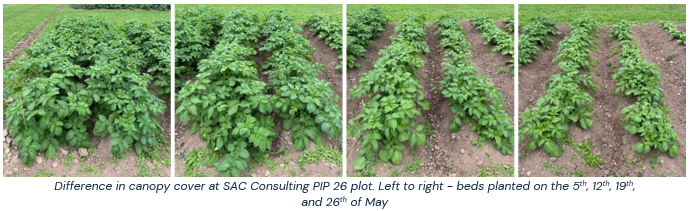
A crop that develops a full canopy early can take advantage of more sunlight during the longest days of the season to maximise photosynthesis and increase dry matter content to support tuber growth. Under this logic, planting at the earliest opportunity generally provides the best chance to reach 100% ground cover before day lengths begin to shorten.
On the other hand, there are advantages to planting by calendar date. Growers targeting yields of tuber sizes on the smaller end of the scale can favour this approach as these crops do not need to maximise on bulking time as much to hit the larger size bands.
In fact, earlier planted crops are at risk of going over sized if careful test digging to assess growth rate is not carried out. Calendar-based planting also simplifies operational planning, helping businesses schedule labour, machinery, and other field operations in advance, rather than at short notice due to changes in weather patterns. However, planting according to calendar date can present risks, as this method does not adapt to annual variations in weather and soil conditions.
Planting into cold, wet soils can result in slow emergence, reduced root development, greater susceptibility to seed-borne disease, and increased risk of soil compaction. In some seasons, crops planted later into warmer soils may emerge more rapidly and establish a canopy sooner than earlier planted crops struggling in poor conditions. As a result, the assumed advantage of an early planting date can quickly be reduced or even eliminated.
This is where a condition-based approach offers potential benefits. Delaying planting until soil temperature, moisture levels, and field conditions are favourable can promote faster emergence and more vigorous early growth. Healthier crop establishment may improve canopy development, reduce stress, contribute to better skin finish and tuber quality at harvest. Such an approach may also help growers respond to increasingly variable weather patterns, adapting decisions to the season rather than relying solely on historical planting windows.
Nevertheless, delayed planting has its own drawbacks. The most obvious challenge is the gradual loss of available growing time and daylight. Crops planted later have fewer opportunities to intercept solar radiation during the longest days of the year, potentially reducing total yield. If canopy closure occurs after the longest day, the crop may never fully compensate for the lost photosynthetic opportunity and accumulated solar hours. For growers targeting high-yielding maincrop production, this can represent a considerable disadvantage.
This year, the SRUC plot is particularly interesting because the planted tubers have experienced a warm and dry season. Weekly measurements of emergence and canopy ground cover will help determine whether later planted crops can compensate for lost growing days through faster establishment. In addition, assessment of yield, tuber size distribution and skin finish quality will provide valuable insights into the trade-offs between tradition and flexibility.
Come and talk to the SAC Consulting Potatoes Team at PIP about maximising potato productivity through improved planting date timing under local growing conditions and
By Dr Kerry Leslie, Potato Consultant, SAC Consulting (part of SRUC)